dn14:1.0 1. On Past Lives
BAGIAN 1
dn14:1.1.1 So I have heard.
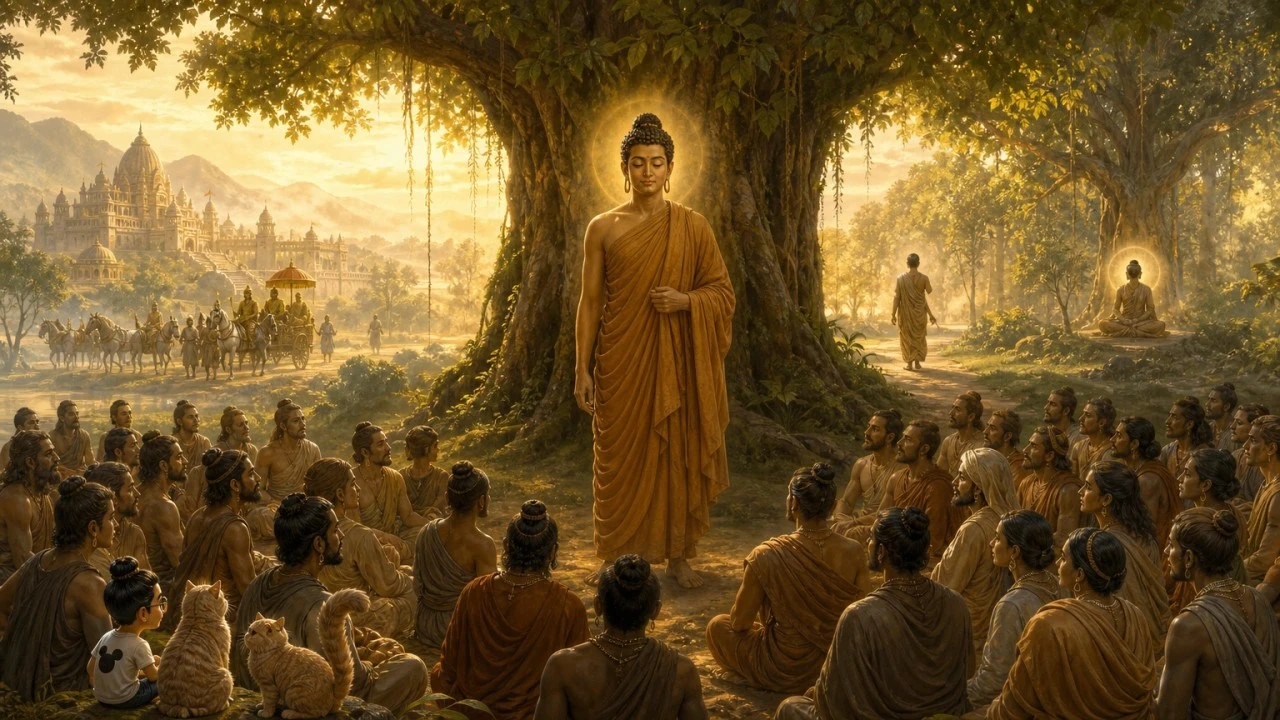
dn14:1.1.2 At one time the Buddha was staying near Sāvatthī in Jeta’s Grove, Anāthapiṇḍika’s monastery, in the hut by the kareri tree.
dn14:1.1.3 Then after the meal, on return from almsround, several mendicants sat together in the pavilion by the kareri tree and this Dhamma talk on the subject of past lives came up among them,
dn14:1.1.4 “So it was in a past life; such it was in a past life.”
dn14:1.2.1 With clairaudience that is purified and superhuman, the Buddha heard that discussion among the mendicants.
dn14:1.2.2 So he got up from his seat and went to the pavilion, where he sat on the seat spread out and addressed the mendicants:
dn14:1.2.3 “Mendicants, what were you sitting talking about just now? What conversation was left unfinished?”
dn14:1.2.4 The mendicants told him what had happened, adding,
dn14:1.2.7 “This is the conversation that was unfinished when the Buddha arrived.”
dn14:1.3.1 “Would you like to hear a Dhamma talk on the subject of past lives?”
dn14:1.3.2 “Now is the time, Blessed One! Now is the time, Holy One!
dn14:1.3.3 Let the Buddha give a Dhamma talk on the subject of past lives. The mendicants will listen and remember it.”
dn14:1.3.4 “Well then, mendicants, listen and apply your mind well, I will speak.”
dn14:1.3.5 “Yes, sir,” they replied.
dn14:1.3.6 The Buddha said this:
dn14:1.4.1 “Ninety-one eons ago, the Buddha Vipassī arose in the world, perfected and fully awakened.
dn14:1.4.2 Thirty-one eons ago, the Buddha Sikhī arose in the world, perfected and fully awakened.
dn14:1.4.3 In the same thirty-first eon, the Buddha Vessabhū arose in the world, perfected and fully awakened.
dn14:1.4.4 In the present fortunate eon, the Buddhas Kakusandha,
dn14:1.4.5 Koṇāgamana,
dn14:1.4.6 and Kassapa arose in the world, perfected and fully awakened.
dn14:1.4.7 And in the present fortunate eon, I have arisen in the world, perfected and fully awakened.
dn14:1.5.1 The Buddhas Vipassī,
dn14:1.5.2 Sikhī,
dn14:1.5.3 and Vessabhū were born as aristocrats into aristocrat families.
dn14:1.5.4 The Buddhas Kakusandha,
dn14:1.5.5 Koṇāgamana,
dn14:1.5.6 and Kassapa were born as brahmins into brahmin families.
dn14:1.5.7 I was born as an aristocrat into an aristocrat family.
dn14:1.6.1 Koṇḍañña was the clan of Vipassī,
dn14:1.6.2 Sikhī,
dn14:1.6.3 and Vessabhū.
dn14:1.6.4 Kassapa was the clan of Kakusandha,
dn14:1.6.5 Koṇāgamana,
dn14:1.6.6 and Kassapa.
dn14:1.6.7 Gotama is my clan.
dn14:1.7.1 For Vipassī, the lifespan was 80,000 years.
dn14:1.7.2 For Sikhī, the lifespan was 70,000 years.
dn14:1.7.3 For Vessabhū, the lifespan was 60,000 years.
dn14:1.7.4 For Kakusandha, the lifespan was 40,000 years.
dn14:1.7.5 For Koṇāgamana, the lifespan was 30,000 years.
dn14:1.7.6 For Kassapa, the lifespan was 20,000 years.
dn14:1.7.7 For me at this time the lifespan is short, brief, and fleeting. A long life is a hundred years or a little more.
dn14:1.8.1 Vipassī was awakened at the root of a patala tree.
dn14:1.8.2 Sikhī was awakened at the root of a white-mango tree.
dn14:1.8.3 Vessabhū was awakened at the root of a sal tree.
dn14:1.8.4 Kakusandha was awakened at the root of a lebbeck tree.
dn14:1.8.5 Koṇāgamana was awakened at the root of a cluster fig tree.
dn14:1.8.6 Kassapa was awakened at the root of a banyan tree.
dn14:1.8.7 I was awakened at the root of a peepal tree.
dn14:1.9.1 Vipassī had a fine pair of chief disciples named Khaṇḍa and Tissa.
dn14:1.9.2 Sikhī had a fine pair of chief disciples named Abhibhū and Sambhava.
dn14:1.9.3 Vessabhū had a fine pair of chief disciples named Soṇa and Uttara.
dn14:1.9.4 Kakusandha had a fine pair of chief disciples named Vidhura and Sañjīva.
dn14:1.9.5 Koṇāgamana had a fine pair of chief disciples named Bhiyyosa and Uttara.
dn14:1.9.6 Kassapa had a fine pair of chief disciples named Tissa and Bhāradvāja.
dn14:1.9.7 I have a fine pair of chief disciples named Sāriputta and Moggallāna.
dn14:1.10.1 Vipassī had three gatherings of disciples—one of 6,800,000, one of 100,000, and one of 80,000—all of them mendicants who had ended their defilements.
dn14:1.10.2 Sikhī had three gatherings of disciples—one of 100,000, one of 80,000, and one of 70,000—all of them mendicants who had ended their defilements.
dn14:1.10.3 Vessabhū had three gatherings of disciples—one of 80,000, one of 70,000, and one of 60,000—all of them mendicants who had ended their defilements.
dn14:1.10.4 Kakusandha had one gathering of disciples—40,000 mendicants who had ended their defilements.
dn14:1.10.5 Koṇāgamana had one gathering of disciples—30,000 mendicants who had ended their defilements.
dn14:1.10.6 Kassapa had one gathering of disciples—20,000 mendicants who had ended their defilements.
dn14:1.10.7 I have had one gathering of disciples—1,250 mendicants who had ended their defilements.
dn14:1.11.1 Vipassī had as chief attendant a mendicant named Asoka.
dn14:1.11.2 Sikhī had as chief attendant a mendicant named Khemaṅkara.
dn14:1.11.3 Vessabhū had as chief attendant a mendicant named Upasanta.
dn14:1.11.4 Kakusandha had as chief attendant a mendicant named Buddhija.
dn14:1.11.5 Koṇāgamana had as chief attendant a mendicant named Sotthija.
dn14:1.11.6 Kassapa had as chief attendant a mendicant named Sabbamitta.
dn14:1.11.7 I have as chief attendant a mendicant named Ānanda.
dn14:1.12.1 Vipassī’s father was King Bandhumā,
dn14:1.12.2 his birth mother was Queen Bandhumatī,
dn14:1.12.3 and their capital city was named Bandhumatī.
dn14:1.12.4 Sikhī’s father was King Aruṇa,
dn14:1.12.5 his birth mother was Queen Pabhāvatī,
dn14:1.12.6 and their capital city was named Aruṇavatī.
dn14:1.12.7 Vessabhū’s father was King Suppatita,
dn14:1.12.8 his birth mother was Queen Vassavatī,
dn14:1.12.9 and their capital city was named Anoma.
dn14:1.12.10 Kakusandha’s father was the brahmin Aggidatta,
dn14:1.12.11 and his birth mother was the brahmin lady Visākhā.
dn14:1.12.12 At that time the king was Khema,
dn14:1.12.13 whose capital city was named Khemavatī.
dn14:1.12.14 Koṇāgamana’s father was the brahmin Yaññadatta,
dn14:1.12.15 and his birth mother was the brahmin lady Uttarā.
dn14:1.12.16 At that time the king was Sobha,
dn14:1.12.17 whose capital city was named Sobhavatī.
dn14:1.12.18 Kassapa’s father was the brahmin Brahmadatta,
dn14:1.12.19 and his birth mother was the brahmin lady Dhanavatī.
dn14:1.12.20 At that time the king was Kikī,
dn14:1.12.21 whose capital city was named Varanasi.
dn14:1.12.22 In this life, my father was King Suddhodana,
dn14:1.12.23 my birth mother was Queen Māyā,
dn14:1.12.24 and our capital city was Kapilavatthu.”
dn14:1.12.25 That is what the Buddha said.
dn14:1.12.26 When he had spoken, the Holy One rose from his seat and entered his dwelling.
dn14:1.13.1 Soon after the Buddha left, those mendicants discussed among themselves:
dn14:1.13.2 “It’s incredible, reverends, it’s amazing! The Realized One has such psychic power and might!
dn14:1.13.3 For he is able to recollect the birth, names, clans, lifespan, chief disciples, and gatherings of disciples of the Buddhas of the past who have become fully quenched, cut off proliferation, cut off the course, finished off the cycle, and passed beyond all suffering:
dn14:1.13.4 ‘Such is the birth, names, clans, conduct, teachings, wisdom, meditation, and freedom of those Blessed Ones.’
dn14:1.13.5 Is it because the Realized One has clearly penetrated the principle of the teachings that he can recollect all these things?
dn14:1.13.6 Or did deities tell him?”
dn14:1.13.7 But this conversation among those mendicants was left unfinished.
dn14:1.14.1 Then in the late afternoon, the Buddha came out of retreat and went to the pavilion by the kareri tree, where he sat down on the seat spread out
dn14:1.14.2 and addressed the mendicants:
dn14:1.14.3 “Mendicants, what were you sitting talking about just now? What conversation was left unfinished?”
dn14:1.14.4 The mendicants told him what had happened, adding,
dn14:1.14.13 “This was our conversation that was unfinished when the Buddha arrived.”
dn14:1.15.1 “It is because the Realized One has clearly penetrated the principle of the teachings that he can recollect all these things.
dn14:1.15.3 And the deities also told me.
dn14:1.15.5 Would you like to hear a further Dhamma talk on the subject of past lives?”
dn14:1.15.6 “Now is the time, Blessed One! Now is the time, Holy One!
dn14:1.15.7 Let the Buddha give a further Dhamma talk on the subject of past lives. The mendicants will listen and remember it.”
dn14:1.15.8 “Well then, mendicants, listen and apply your mind well, I will speak.”
dn14:1.15.9 “Yes, sir,” they replied.
dn14:1.15.10 The Buddha said this:
dn14:1.16.1 “Ninety-one eons ago, the Buddha Vipassī arose in the world, perfected and fully awakened.
dn14:1.16.2 He was born as an aristocrat into an aristocrat family.
dn14:1.16.3 His clan was Koṇḍañña.
dn14:1.16.4 He lived for 80,000 years.
dn14:1.16.5 He was awakened at the root of a patala tree.
dn14:1.16.6 He had a fine pair of chief disciples named Khaṇḍa and Tissa.
dn14:1.16.7 He had three gatherings of disciples—
dn14:1.16.8 one of 6,800,000, one of 100,000, and one of 80,000—
dn14:1.16.9 all of them mendicants who had ended their defilements.
dn14:1.16.10 He had as chief attendant a mendicant named Asoka.
dn14:1.16.11 His father was King Bandhumā,
dn14:1.16.12 his birth mother was Queen Bandhumatī,
dn14:1.16.13 and their capital city was named Bandhumatī.
dn14:1.17.0 2. What’s Normal For One Intent on Awakening
dn14:1.17.1 When Vipassī, the being intent on awakening, passed away from the host of joyful gods, he was conceived in his mother’s womb, mindful and aware.
dn14:1.17.2 This is normal in such a case.
dn14:1.17.3 It’s normal that, when the being intent on awakening passes away from the host of joyful gods, he is conceived in his mother’s womb.
dn14:1.17.4 And then—in this world with its gods, Māras, and divinities, this population with its ascetics and brahmins, gods and humans—an immeasurable, magnificent light appears, surpassing the glory of the gods.
dn14:1.17.5 Even in the boundless gloom of interstellar space—so utterly dark that even the luminosity of the moon and the sun, so mighty and powerful, makes no impression—an immeasurable, magnificent light appears, surpassing the glory of the gods.
dn14:1.17.6 And the sentient beings reborn there recognize each other by that light: ‘So, it seems other sentient beings have been reborn here!’
dn14:1.17.7 And this ten-thousandfold galaxy shakes and rocks and trembles. And an immeasurable, magnificent light appears in the world, surpassing the glory of the gods.
dn14:1.17.8 This is normal in such a case.
dn14:1.17.9 It’s normal that, when the being intent on awakening is conceived in his mother’s womb, four godlings approach to guard the four quarters, so that no human or non-human or anyone at all shall harm the being intent on awakening or his mother.
dn14:1.17.10 This is normal in such a case.
dn14:1.18.1 It’s normal that, when the being intent on awakening is conceived in his mother’s womb, she becomes naturally ethical. She refrains from killing living creatures, stealing, sexual misconduct, lying, and beer, wine, and liquor intoxicants.
dn14:1.18.2 This is normal in such a case.
dn14:1.19.1 It’s normal that, when the being intent on awakening is conceived in his mother’s womb, she no longer thinks of men in a sexual way, and she cannot be violated by a man of lustful intent.
dn14:1.19.2 This is normal in such a case.
dn14:1.20.1 It’s normal that, when the being intent on awakening is conceived in his mother’s womb, she obtains the five kinds of sensual stimulation and amuses herself, supplied and provided with them.
dn14:1.20.2 This is normal in such a case.
dn14:1.21.1 It’s normal that, when the being intent on awakening is conceived in his mother’s womb, no afflictions beset her. She’s happy and free of bodily fatigue. And she sees the being intent on awakening in her womb, whole in his major and minor limbs, not deficient in any faculty.
dn14:1.21.2 Suppose there was a beryl gem that was naturally lustrous, eight-faceted, well-worked, transparent, clear, and unclouded, endowed with all good qualities. And it was strung with a thread of blue, yellow, red, white, or golden brown.
dn14:1.21.3 And a person with clear eyes were to take it in their hand and examine it: ‘This beryl gem is naturally lustrous, eight-faceted, well-worked, transparent, clear, and unclouded, endowed with all good qualities. And it’s strung with a thread of blue, yellow, red, white, or golden brown.’
dn14:1.21.4 In the same way, when the being intent on awakening is conceived in his mother’s womb, no afflictions beset her. She’s happy and free of bodily fatigue. And she sees the being intent on awakening in her womb, whole in his major and minor limbs, not deficient in any faculty.
dn14:1.21.5 This is normal in such a case.
dn14:1.22.1 It’s normal that, seven days after the being intent on awakening is born, his mother passes away and is reborn in the host of joyful gods.
dn14:1.22.2 This is normal in such a case.
dn14:1.23.1 It’s normal that, while other women carry the infant in the womb for nine or ten months before giving birth, not so the mother of the being intent on awakening. She gives birth after exactly ten months.
dn14:1.23.2 This is normal in such a case.
dn14:1.24.1 It’s normal that, while other women give birth while sitting or lying down, not so the mother of the being intent on awakening. She only gives birth standing up.
dn14:1.24.2 This is normal in such a case.
dn14:1.25.1 It’s normal that, when the being intent on awakening emerges from his mother’s womb, gods receive him first, then humans.
dn14:1.25.2 This is normal in such a case.
dn14:1.26.1 It’s normal that, when the being intent on awakening emerges from his mother’s womb, before he reaches the ground, four godlings receive him and place him before his mother, saying: ‘Rejoice, O Queen! An illustrious son is born to you.’
dn14:1.26.2 This is normal in such a case.
dn14:1.27.1 It’s normal that, when the being intent on awakening emerges from his mother’s womb, he emerges already clean, unsoiled by waters, mucus, blood, or any other kind of impurity, pure and clean.
dn14:1.27.2 Suppose a jewel-treasure was placed on a cloth from Kāsi. The jewel would not soil the cloth, nor would the cloth soil the jewel.
dn14:1.27.3 Why is that?
dn14:1.27.4 Because of the cleanliness of them both.
dn14:1.27.5 In the same way, when the being intent on awakening emerges from his mother’s womb, he emerges already clean, unsoiled by waters, mucus, blood, or any other kind of impurity, pure and clean.
dn14:1.27.6 This is normal in such a case.
dn14:1.28.1 It’s normal that, when the being intent on awakening emerges from his mother’s womb, two showers of water appear from the sky, one cool, one warm, for bathing the being intent on awakening and his mother.
dn14:1.28.2 This is normal in such a case.
dn14:1.29.1 It’s normal that, as soon as he’s born, the being intent on awakening stands firm with his own feet on the ground. Facing north, he takes seven strides with a white parasol held above him, surveys all quarters, and makes this dramatic proclamation: ‘I am the foremost in the world! I am the eldest in the world! I am the first in the world! This is my last rebirth; now there’ll be no more future lives.’
dn14:1.29.2 This is normal in such a case.
dn14:1.30.1 It’s normal that, when the being intent on awakening emerges from his mother’s womb, then—in this world with its gods, Māras, and divinities, this population with its ascetics and brahmins, gods and humans—an immeasurable, magnificent light appears, surpassing the glory of the gods.
dn14:1.30.2 Even in the boundless gloom of interstellar space—so utterly dark that even the luminosity of the moon and the sun, so mighty and powerful, makes no impression—an immeasurable, magnificent light appears, surpassing the glory of the gods.
dn14:1.30.3 And the sentient beings reborn there recognize each other by that light: ‘So, it seems other sentient beings have been reborn here!’
dn14:1.30.4 And this ten-thousandfold galaxy shakes and rocks and trembles. And an immeasurable, magnificent light appears in the world, surpassing the glory of the gods.
dn14:1.30.5 This is normal in such a case.
dn14:1.31.0 3. The Thirty-Two Marks of a Great Man
dn14:1.31.1 When Prince Vipassī was born, they announced it to King Bandhumā,
dn14:1.31.2 ‘Your Majesty, your son is born! Let Your Majesty examine him!’
dn14:1.31.3 When the king had examined the prince, he had the brahmin soothsayers summoned and said to them,
dn14:1.31.4 ‘Gentlemen, please examine the prince.’
dn14:1.31.5 When they had examined him they said to the king,
dn14:1.31.6 ‘Rejoice, O King! An illustrious son is born to you. You are fortunate, so very fortunate, to have a son such as this born in this family!
dn14:1.31.7 For the prince possesses the thirty-two marks of a great man. A great man who possesses these has only two possible destinies, no other.
dn14:1.31.8 If he stays at home he becomes a king, a wheel-turning monarch, a just and principled king. His dominion extends to all four sides, he achieves stability in the country, and he possesses the seven treasures.
dn14:1.31.9 He has the following seven treasures:
dn14:1.31.10 the wheel, the elephant, the horse, the jewel, the woman, the householder, and the commander as the seventh treasure.
dn14:1.31.11 He has over a thousand sons who are valiant and heroic, crushing the armies of his enemies.
dn14:1.31.12 After conquering this land girt by sea, he reigns by principle, without rod or sword.
dn14:1.31.13 But if he goes forth from the lay life to homelessness, he becomes a perfected one, a fully awakened Buddha, who has cast off the veil from the world.
dn14:1.32.1 And what are the marks which he possesses?
dn14:1.32.7 He has well-planted feet.
dn14:1.32.8 On the soles of his feet there are thousand-spoked wheels, with rims and hubs, complete in every detail.
dn14:1.32.9 He has stretched heels.
dn14:1.32.10 He has long fingers.
dn14:1.32.11 His hands and feet are soft and tender.
dn14:1.32.12 He has serried hands and feet.
dn14:1.32.13 The tops of his feet are arched.
dn14:1.32.14 His calves are like those of an antelope.
dn14:1.32.15 When standing upright and not bending over, the palms of both hands touch the knees.
dn14:1.32.16 His private parts are sheathed in a foreskin.
dn14:1.32.17 He is golden colored; his skin shines like lustrous gold.
dn14:1.32.18 He has delicate skin, so delicate that dust and dirt don’t stick to his body.
dn14:1.32.19 His hairs grow one per pore.
dn14:1.32.20 His hairs stand up; they’re blue-black and curl clockwise.
dn14:1.32.21 His body is tall and straight-limbed.
dn14:1.32.22 He has bulging muscles in seven places.
dn14:1.32.23 His chest is like that of a lion.
dn14:1.32.24 He is filled out between the shoulders.
dn14:1.32.25 He has the proportional circumference of a banyan tree: the span of his arms equals the height of his body.
dn14:1.32.26 His torso is cylindrical.
dn14:1.32.27 He has ridged taste buds.
dn14:1.32.28 His jaw is like that of a lion.
dn14:1.32.29 He has forty teeth.
dn14:1.32.30 His teeth are even.
dn14:1.32.31 His teeth have no gaps.
dn14:1.32.32 His teeth are perfectly white.
dn14:1.32.33 He has a large tongue.
dn14:1.32.34 He has the voice of the Divinity, like a cuckoo’s call.
dn14:1.32.35 His eyes are indigo.
dn14:1.32.36 He has eyelashes like a cow’s.
dn14:1.32.37 Between his eyebrows there grows a tuft, soft and white like cotton-wool.
dn14:1.32.38 The crown of his head is like a turban.
dn14:1.33.1 These are the thirty-two marks of a great man that the prince has. A great man who possesses these has only two possible destinies, no other.
dn14:1.33.2 If he stays at home he becomes a king, a wheel-turning monarch.
dn14:1.33.7 But if he goes forth from the lay life to homelessness, he becomes a perfected one, a fully awakened Buddha, who has cast off the veil from the world.’
dn14:1.33.8.0 4. How He Came to be Known as Vipassī
dn14:1.33.9 Then King Bandhumā had the brahmin soothsayers dressed in unworn clothes and satisfied all their needs.
dn14:1.34.1 Then the king appointed nursemaids for Prince Vipassī.
dn14:1.34.2 Some suckled him, some bathed him, some held him, and some carried him on their hip.
dn14:1.34.3 From when he was born, a white parasol was held over him night and day, with the thought,
dn14:1.34.4 ‘Don’t let cold, heat, grass, dust, or damp bother him.’
dn14:1.34.5 He was dear and beloved by many people,
dn14:1.34.6 like a blue water lily, or a pink or white lotus.
dn14:1.34.8 He was always passed from hip to hip.
dn14:1.35.1 From when he was born, his voice was charming, graceful, sweet, and endearing.
dn14:1.35.2 It was as sweet as the song of a cuckoo-bird found in the Himalayas.
dn14:1.36.1 From when he was born, Prince Vipassī had the power of clairvoyance which manifested as a result of past deeds, by which he could see for a league all around both by day and by night.
dn14:1.37.1 And he was unblinkingly watchful, like the gods of the thirty-three.
dn14:1.37.2 And because it was said that he was unblinkingly watchful, he came to be known as ‘Vipassī’.
dn14:1.37.3 Then while King Bandhumā was sitting in court, he’d sit Prince Vipassī in his lap and explain the case to him.
dn14:1.37.4 And sitting there in his father’s lap, Vipassī would thoroughly consider the case and draw a conclusion using a logical system.
dn14:1.37.5 So this was all the more reason for him to be known as ‘Vipassī’.
dn14:1.38.1 Then King Bandhumā had three stilt longhouses built for him—one for the winter, one for the summer, and one for the rainy season,
dn14:1.38.2 and provided him with the five kinds of sensual stimulation.
dn14:1.38.3 Prince Vipassī stayed in a stilt longhouse without coming downstairs for the four months of the rainy season, where he was entertained by musicians—none of them men.
dn14:1.38.4 The first recitation section.